Integrated Pest Management
Through 25 years of experience, and new research developments, we have learned to use the minimum amount of selective pesticides. The goal is to minimize the environmental impact and produce a product with insignificant residue, while producing quality, saleable fruit. Testing the lower thresholds of chemical protection has resulted in economic losses in some years due to insect or disease, but has been valuable for elucidating the lower limits. Sanitation, pruning practices, nutrition, and ground-cover management all play a part in protecting the orchard and producing quality products.
To limit insect damage, the presence of pest and predator species are
monitored throughout the growing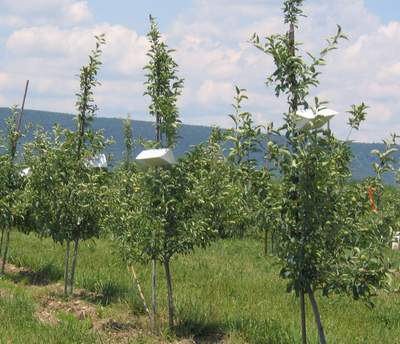 season. Levels of pests are tolerated that will
not likely cause excessive damage. Even higher levels of pests are sometimes not
eliminated if there is a good possibility that there will be sufficient control
by developing predators. When an insecticide is required, the one that will
control the pest(s) present while not harming other insects or predators is
used. Some new insecticides have very low general toxicity and only require one
or two ounces of active ingredient per acre. A relatively new insect-control method,
requiring no insecticide, involves pheromone dispensers for moth mating disruption.
season. Levels of pests are tolerated that will
not likely cause excessive damage. Even higher levels of pests are sometimes not
eliminated if there is a good possibility that there will be sufficient control
by developing predators. When an insecticide is required, the one that will
control the pest(s) present while not harming other insects or predators is
used. Some new insecticides have very low general toxicity and only require one
or two ounces of active ingredient per acre. A relatively new insect-control method,
requiring no insecticide, involves pheromone dispensers for moth mating disruption.
Pheromone Traps for Monitoring Pest Moths
We have used mating disruption for controlling oriental fruit moth very
successfully since 2001, and we have always monitored insects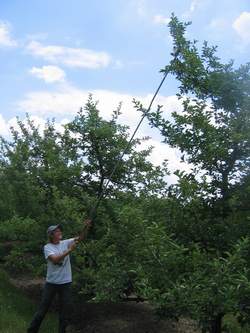 with
species-specific lures and traps. In 2008 we were able to expand our IPM
efforts even more through a grant from the US Dept of Agriculture NRCS.
With the grant we were able to increase our monitoring to 60 traps. Also,
we expanded the moth control by mating disruption to additionally include the
codling moth (the most common internal apple worm), which had become
increasingly prevalent and harder to control. The NRCS funding also went
toward establishing beneficial predator mites and helped pay for the additional
cost of using the newest, least toxic, most pest specific (not harming
beneficial insects) pesticides.
with
species-specific lures and traps. In 2008 we were able to expand our IPM
efforts even more through a grant from the US Dept of Agriculture NRCS.
With the grant we were able to increase our monitoring to 60 traps. Also,
we expanded the moth control by mating disruption to additionally include the
codling moth (the most common internal apple worm), which had become
increasingly prevalent and harder to control. The NRCS funding also went
toward establishing beneficial predator mites and helped pay for the additional
cost of using the newest, least toxic, most pest specific (not harming
beneficial insects) pesticides.
Hanging moth pheromone loops in tops
of trees
There are some other specific measures that we use to minimize pest control
impact. Spraying lower rates of insecticides at more frequent intervals also helps to
decrease the total amount of pesticide used. The shorter duration allows timing
the application to the specific need rather than spraying the trees weeks apart
with enough chemical to cover the possibility that it is needed. Also, less
total pesticide is required with shorter spray intervals, because the minimum
effective level is maintained with small amounts instead of the much larger
amounts required to remain in the orchard after most of it breaks down or washes
off. Of course, as noted above, many insecticide applications can be eliminated
when not required. Specifically, we have found (contrary to common practice)
that we can always eliminate all prebloom peach and apple insecticides.
Similarly, we typically increase days-to-harvest limitations by factors of two
or three, and in many cases use insecticide rates that are a fraction of
permissible levels.
Disease control is targeted only when its propagation is likely. This mainly takes the form of fungicide applications just before or just after wet periods in the spring. The length of time the leaves and fruit are wet, the temperature, the amount of inoculum present, and the growth stage of the trees determine if an outbreak could occur. When the combination of the levels of these factors is considered, the fungicide treatment can often be reduced. As with insecticides, new fungicides (such as the strobilurins first discovered in certain mushrooms) are available that only require one or two ounces of active ingredient per acre.